For some time now, the same conversation keeps repeating in our waiting room at the clinic in Ochota. The owner of a six-month-old puppy sighs: "I don't think he'll ever be house-trained, we've tried everything." A moment later it turns out that "everything" meant three different methods used alternately over two weeks, a crate used as punishment, and mounting frustration on both ends of the leash. There's a convenient excuse circulating on internet forums, too: a six-month-old dog is still "practically a puppy," so surely he has the right to pee wherever he likes, because he's so small and sweet. We disagree with that completely. Everything your dog does, they do because that's how they were taught, or not taught. Eight-week-old puppies raised well by a breeder can already signal fairly reliably that they need to go outside. There's no reason a twelve-week-old puppy couldn't hold on until the next outing, if someone is teaching them consistently. This article is a complete guide to house-training: why a puppy pees where they pee, how to plan the first days at home, what a proven step-by-step method looks like, which mistakes to avoid, and when a house-training problem stops being a training issue and becomes a health signal that needs a vet visit.
Why a Puppy Pees Indoors – A Puppy's-Eye View
Remember being little, before school age? Needing to pee on a walk in the park, at the cinema, in a shop, and being too embarrassed to tell your parent? Or being on a school trip with nobody around to ask where the toilet was? Not everyone went through exactly that, but most puppies react to a new environment in precisely this way. An act as intimate as relieving oneself is tightly bound up with a sense of safety. So it shouldn't surprise us that a puppy will try to do it somewhere they can relax, not necessarily wherever their owner would prefer.
And the street a tiny puppy steps out onto isn't safe at all. Huge cars, huge houses, huge people who, on top of everything, stop, lean over, goggle their eyes, and make sounds somewhere between a frog's croak and a mouse squealing in a trap – from a dog's point of view, all of this is at best suspicious. When a puppy leaves the nest, where it was warm, familiar, and safe, and where they were praised for going on the puppy pad, the first thing they have to do is watch their surroundings. And a great deal is happening at once. They need to stay alert, ready to flee, yet also open to contact with these loud, squealing people and other dogs. When a puppy finally spots another dog, they might feel delighted, or frightened, if the other dog is big, barking, or a stranger.
Safety and Scent as an Anchor
As a result, a young puppy does exactly what a frightened preschooler would do in the same spot: they hold everything in with all their might until they're back in the safe shelter of their own home. Then comes the relief. The trouble is that "safe shelter" in a puppy's head is still the inside of the flat, not a specific spot outdoors, until you teach them that the same calm they're used to indoors is waiting for them outside too, as part of your regular walking routine.
It Isn't About Age. It's About Consistency
Worth underlining: age isn't the main obstacle here. A very young puppy, eight to ten weeks old, genuinely has a small bladder and can't hold on for long, so at that stage what matters most is how often you offer the opportunity to go in the right place, not how patient the puppy is. But whether a six-month-old dog is house-trained depends almost entirely on how consistently they were taught from day one in their new home, not on how many months old they are. Treating age as an excuse for skipping the training works against you: it reinforces the habit of going indoors instead of replacing it.
Bladder and Bowel Development: What to Realistically Expect
The First Weeks at Home
In the first weeks after moving into a new home, a puppy has very limited control over their bladder and bowels. This is entirely natural and has nothing to do with stubbornness or bad will. What matters most at this stage is giving them as many opportunities as possible to go in the right place, after every time they wake up, after every meal, and after every energetic play session, before an indoor accident even has the chance to happen. The more often a puppy ends up in the right spot, the faster the right habit takes hold.
From the Fourth to the Sixth Month
As puppies get older, control over the bladder and bowel muscles gradually improves. Many puppies, with consistent training from day one, become reliably house-trained well before they turn six months old. That's an average picture, though; for some dogs the process takes a bit longer, especially if training started later or was inconsistent. The odd accident during teething, illness, a change in diet, or an unusually exciting or stressful situation happens even to puppies who've been doing well for weeks, and on its own it's no reason for concern or for going back to square one in training.
Does Breed Matter
Toy and miniature breed puppies have physically smaller bladders and a faster metabolism, so they sometimes need a little more patience and more frequent outings than their larger peers. Large breeds mature at their own pace in plenty of other respects, too. In clinical practice, the individual differences between specific puppies, temperament, stress levels, how the training is run, matter more than breed alone.
Before You Start: Preparing Your Home and Schedule
Set a Firm Feeding and Walking Schedule
A predictable feeding schedule makes it much easier to predict when a puppy will need to go out. It's worth planning regular outings around several fixed moments:
- right after waking up, before the puppy has a chance to run around the flat,
- within a few minutes of finishing a meal,
- immediately after any energetic play session,
- before bed, including before the night's sleep.
Feeding at set times, rather than leaving food out "all day," has an added benefit: it also lets you predict when the puppy will need to have a bowel movement, which for many owners is harder to plan around than peeing alone.
Choose a Method That Fits Your Situation
The end goal is teaching the puppy to go outside. In practice, the road to that goal looks different in a house with a garden than in a flat on the tenth floor with a lift that isn't exactly reliable at four in the morning. If you live high up, a temporary training pad or a litter tray filled with peat or artificial turf, placed near the front door, can help in the first few days, treated as a transitional stage, not as the end goal itself. The key is to gradually move the same ritual and the same cue word outdoors as soon as the logistics allow, so the puppy doesn't settle into thinking indoors is just as good a place to go as the street.
Night-Time Rhythm and the First Nights at Home
The first nights in a new home tend to be the hardest, for the puppy and for the sleep-deprived owner alike. It helps to pick up the water bowl an hour or two before bed to reduce the risk of a night-time accident, but never restrict water access during the day. Placing the bed or crate in the bedroom, or right next to it, tends to work well: the puppy feels the owner's closeness, and you'll hear the quiet whimper that signals a need to go out before it turns into desperate barking. The last outing right before lights out and the first one right after waking, before your morning coffee, are the two most important points in the whole daily schedule. In the first few weeks, night-time wake-ups for a short, businesslike outing with no play and no lengthy cuddles are the norm, not a failure; over time, as the bladder matures, the gaps between them stretch out on their own.
The Crate: An Ally, Not a Punishment
A crate, introduced gradually and positively, is one of the most effective tools in house-training, provided the puppy associates it with safety rather than isolation or punishment. At the start, it helps to feed meals inside it and leave the door open, so the puppy chooses to go in on their own. Size matters: the crate should be large enough for the puppy to turn around, stand up, and lie down comfortably, but not so large that they can relieve themselves in one corner and sleep peacefully in the other; too much space undermines a dog's natural reluctance to soil their own bed. Dog trainers often mention a rough rule of thumb: the puppy's age in months, plus roughly an hour, as an upper limit on how long they can hold it during the day. That's only a guideline, not a fixed rule; small, very young, or especially anxious puppies may need breaks far more often, and at night, when metabolism slows down, many dogs can hold on longer than they can during the day.
A crate should never be something a puppy associates with punishment. If you shut a puppy in "as punishment" after an accident at home, you're teaching them that the crate is a bad place, and it stops working as the safe base it was meant to be from the start.
Step by Step: Teaching a Puppy to Go in One Fixed Spot
The method below has worked in our practice for years and rests on one simple idea: for the first few days, you do everything possible to make sure the puppy never has a single opportunity to go indoors, and every time they go outside, it ends with a calm reward.
Rules Worth Taking as Given
- After every meal, play session, and nap, a puppy needs to relieve themselves. That's physiology, not stubbornness or bad will.
- They'll do it wherever they feel safe, anywhere except their own bed.
- They won't wait for you to tie your shoelaces, put on a jacket, or finish your morning coffee. In the morning, take the puppy out first and see to yourself afterwards.
- If they don't go within the first five to ten minutes outside, they most likely won't go at all during that outing, no matter how long you keep walking.
- The first few days are a time investment that pays off. The more consistently you watch the puppy at the start, the faster they grasp the idea.
A Plan for the First Three Days
- Watch and get ahead of it. You already know your puppy's rhythm, that they go after every nap, every meal, every play session, so keep your shoes and lead within reach before that moment arrives. If it's the crack of dawn, you need to wake up before they do.
- Leave your phone at home. Those few minutes need your full attention, not half of it.
- Find a small, secluded patch of lawn, away from other dogs and people. Four to five square metres, ideally bordered by shrubs, is plenty to start with.
- Carry the puppy there, or walk them there on a lead, stand still, and let them sniff around. Don't chatter at them; just repeat one cue word you want them to associate with the act, for example "go potty."
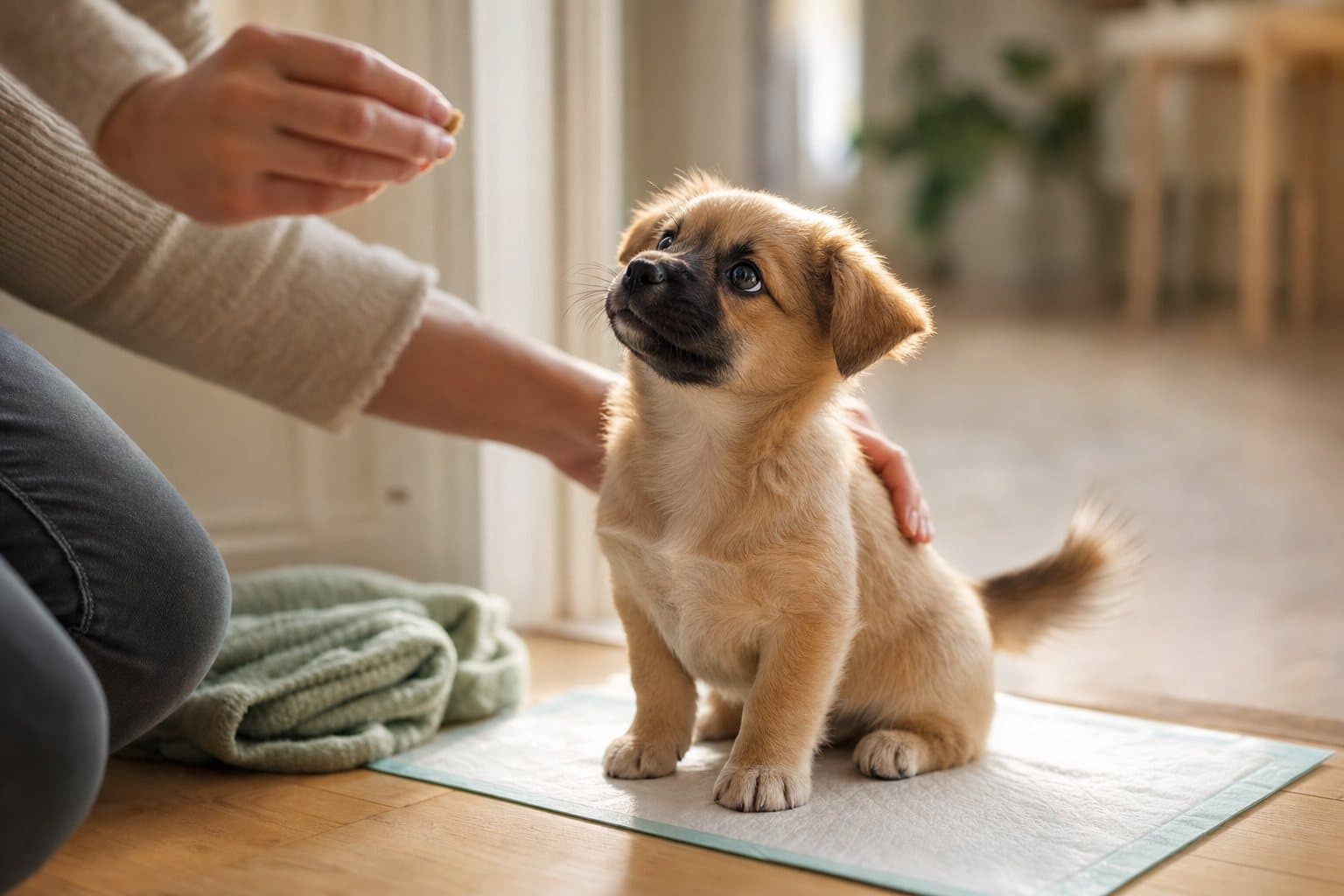
- When they go, praise them in a calm, warm tone. A treat isn't essential, though it certainly doesn't hurt.
- If nothing happens within five to ten minutes, go back home. For the next twenty minutes, keep the puppy in sight, in your arms, on a lead right beside you, or in the crate.
- After those twenty minutes, repeat the whole procedure again. And again, if needed. And again.
For three days we repeat this procedure, a hundred times a day if that's what it takes, though each following day is usually easier than the last. Everything above applies just as much to number two as to number one: the rules of safety, observation, and positive reinforcement are identical for both.
Expanding the Territory
Once you notice the puppy managing without trouble in the designated spot, you can gradually widen the walking area. Always wait for the first successful outing in the new, larger area, though, before assuming the habit has fully carried over to the new spot.
The most common reason for setbacks isn't a stubborn puppy, it's an inconsistent owner: one day of intensive training, then a week off, and you're more or less starting over.
Positive Reinforcement: Reward What You Want to See Again
When to Reward
A reward only makes sense if the puppy can connect it to what they just did. That means praising within a few seconds of them finishing, not on the walk back home, not after you've taken the lead off, but right there, in that exact spot, at that exact moment.
What to Reward With
A combination of a few simple elements works best: a calm, warm tone of voice, a small treat kept handy on every walk, and a moment of play with a favourite toy. It's worth matching the form of the reward to the individual dog's temperament; a very excitable puppy is often better off being calmed down first rather than wound up even further with a loud, enthusiastic round of praise right after they've gone.
What to Avoid at All Costs
- shouting or scolding when you find a puddle after the fact,
- rubbing the puppy's nose in it, a method that teaches nothing except fear,
- showing the puppy the "evidence" after the fact, once they no longer remember what they did,
- swatting with a rolled-up newspaper or a smack, a myth from a bygone era, ineffective and damaging to your relationship with the dog,
- shutting the puppy in the crate as a form of punishment.
A puppy who gets shouted at after the fact doesn't learn "don't do this in the house." They learn "don't do this in front of my owner," and start hiding to relieve themselves, which makes further training even harder.
The Most Common Mistakes in House-Training
- Taking the puppy out "just in case" on a fixed schedule instead of responding to that particular puppy's actual rhythm; a routine copied from the internet will never replace watching your own dog.
- Inconsistency at home; different family members applying different rules or different cue words, so the puppy gets mixed signals and learns more slowly.
- Restricting water access to make the dog "pee less," which doesn't solve the problem and can harm hydration and the puppy's overall wellbeing.
- Expanding freedom around the flat too quickly, before the puppy has actually mastered the basics; extra square metres mean extra, harder-to-predict opportunities for an accident.
- Cleaning accidents with ammonia-based products, which smell similar to urine and can actually encourage the dog to return to the same spot rather than discourage it.
- Punishing after the fact instead of responding during or right after the event; a delayed punishment has no connection, for the dog, to the act itself.
- Ignoring the signals that a puppy wants to go out because something more important is happening at that moment; ignore a few signals in a row and the dog stops flagging them at all.
- Giving up after the first hard week instead of holding the line for just a few more days, right around when results usually start to show.
- Relying too heavily on an indoor training pad even once the logistics allow for regular outdoor walks, which drags the transitional stage out far longer than necessary.
- Treating every accident as a return to square one; a single relapse after weeks of success is usually a minor correction, not a sign you need to start the whole method over.
Accidents Happen: What to Do About an Indoor Slip-Up
If you catch the puppy in the act, a short, neutral sound instead of shouting, a quick scoop up, finishing outside, and then calm praise for finishing in the right place. If you find a puddle after the fact, there's nothing to correct; the window in which the puppy could connect their behaviour to your reaction closed long ago. In that situation, simply clean up and go back to your regular outing routine. For cleaning, it's worth using an enzymatic cleaner designed to break down pet urine odour rather than an ordinary ammonia-based product; enzymes break the scent compounds down instead of just masking them, so the spot stops smelling "like a toilet" to the dog.
Until the puppy has mastered the basics, it helps to limit how freely they can roam the flat unsupervised. Baby gates across doorways between rooms, closed doors to rooms where you can't keep an eye on them, or a short lead clipped to your belt while you're busy with something at home, none of this is overprotective; it's simply managing risk during the training period. The fewer chances for an unsupervised accident, the faster the desired habit takes hold, and the fewer spots around the house carry the scent of urine, the fewer "tempting" places the puppy has to return to.
A Puppy in a Home with Other Pets
If an adult dog, not necessarily a fully trained one, already lives in the house, it's worth making sure the puppy doesn't pick up bad habits from them by imitation; young dogs happily copy older housemates' behaviour, including the behaviour you don't want. In the first few weeks, it's better to take both dogs out separately, or at least make sure each one gets their own round of praise at the right moment, so there's no doubt about which dog did what and where. In homes with a cat, make sure the litter tray sits somewhere the curious, approaching puppy can't reach, both for hygiene and because a dog suddenly barging in while the cat is using the tray can be a source of stress for the cat, which can in turn affect the cat's own litter box habits.
Excitement and Submissive Urination – Not a House-Training Problem
Excitement urination and submissive urination are a separate category altogether. This usually affects young, very sociable puppies and shows up most often during greetings: when you come home, when someone leans over the dog, when an exciting new person appears. It's often accompanied by a lowered body posture, rolling onto the back, or avoiding eye contact. This behaviour usually eases as the puppy matures and grows in confidence, and scolding only makes it worse, because it heightens the very anxiety driving it in the first place. What helps is greeting the puppy calmly, at their level, without leaning over them and without an overly enthusiastic welcome at the door, along with building the puppy's confidence through gentle, positive socialisation.
Signs a Puppy Is About to Go
- suddenly circling in one spot,
- intense sniffing at the floor,
- heading towards the front door,
- stopping mid-play and seeming to "freeze" for a moment,
- whimpering or a characteristic crouching stance.
How Long Does It Take? A Realistic Timeline
The first week tends to be the hardest. Most puppies show clear improvement within the first two to three weeks of consistent work, and many dogs reach full reliability before they turn six months old. Every dog has their own pace, though, and the odd relapse during teething, illness, a house move, or another major stressor is entirely normal and doesn't mean you have to start training from zero.
An Adult Dog with No Previous House-Training
More and more often, our clinic sees adult dogs adopted from shelters or rescues who never had the chance to learn to go in one particular spot. The good news is that the method described above works just as well for an adult dog as for a puppy, often even better, since an adult body can physically hold on longer between outings. The difference is mainly that an adult dog may have spent months or years reinforcing other habits, so the change calls for more patience at the start and even stricter limits on unsupervised movement around the house in the first few days. It's also worth remembering that some adult dogs with a history of neglect had very limited access to the outdoors, so their first reaction to a new, stable home can be a kind of catching-up, more frequent urination than they'll eventually need, whenever the chance arises. That usually settles down gradually over the first few weeks, as the dog learns that outdoor outings will keep happening on a reliable schedule and there's no need to rush or "stock up."
Gardens, Balconies, and Tenth-Floor Flats
Whether your garden measures a hundred square metres or three hectares, the rule stays the same: when you let a small puppy outside, you go with them. You don't stand in the doorway with your coffee. You don't stand in the doorway with your cigarette. You don't stand on the threshold waving your hand towards the garden. You go outside with the dog, you're present, you watch, and you praise at the right moment. In flats without direct garden access, planning the logistics ahead of time is essential: the lift, the stairwell, how long it takes to reach the nearest patch of grass, so the trip outside doesn't end up taking longer than the puppy's bladder has patience for.
When to Consult a Vet or a Behaviourist
If a dog who was previously reliable suddenly starts having accidents indoors again, if they're urinating very often in small amounts with visible straining, if they're drinking noticeably more than usual, or if you notice blood in the urine, these are signs that can point to a urinary tract infection, parasites, or another health issue, rather than a training setback. In that case, the first step should be a visit to the vet, not repeating the whole training method from scratch. Separately, if despite months of consistent, correctly run training a puppy still can't stay clean indoors, or if the fear- or submission-related urination described above doesn't ease up despite a gentle approach, it's worth consulting a certified dog behaviourist, who can help put together an individual plan. Getting advice early usually saves weeks of unnecessary frustration.
Frequently Asked Questions
At what age should a puppy be house-trained?
There's no single fixed date. With consistent training from day one at home, many puppies become reliably house-trained well before they turn six months old, though for some dogs, especially toy breeds, the process takes a bit longer. What matters most is the owner's consistency, not the dog's age on its own.
Should I teach my puppy to go outside straight away, or start with an indoor pad first?
Outdoors is always the end goal. An indoor pad or litter tray makes sense as a temporary solution, mainly in flats on high floors, until the logistics allow for regular outings. It's worth treating it as a transitional stage and moving the same ritual outdoors as soon as you reasonably can.
My dog used to be house-trained, and now they've started peeing indoors again. What's going on?
A sudden relapse after a period of full reliability is a signal to rule out health causes, such as a urinary tract infection, at the vet first. If the examination doesn't turn up a health problem, it's worth looking for the cause in changes at home, a new family member, a house move, a shift in the daily schedule, and going back to closely watching the outing routine for a while.
Can I punish a puppy for a puddle I found after the fact?
No. A puppy can't connect a punishment to something that happened minutes or hours earlier, so that reaction teaches them nothing except fear of their owner. The only moment a reaction makes sense is catching the dog in the act, and even then it should be a calm interruption, not shouting.
How long can a puppy hold it in a crate without going outside?
A rough guideline used in dog training is the puppy's age in months, plus roughly an hour, as an upper limit during the day. It's only a guideline; small, very young, or anxious puppies may need breaks more often, and at night, with a slower metabolism, many dogs can hold on longer.
Why does my puppy pee out of excitement when I come home?
This is most likely excitement or submissive urination, common in young, sociable dogs during greetings. It usually eases with age and growing confidence. A calm, low-key greeting at the dog's level helps; shouting or scolding only makes it worse.
Do large and small breeds learn house-training at the same pace?
Not always identically, but the differences mostly come down to bladder size and metabolic rate, not the "intelligence" of a given breed. Toy breed puppies often need slightly more frequent outings and a little extra patience. The training method itself stays the same regardless of the dog's size.
House-training is a marathon made up of very short, repeated moments: a few minutes of watching, one cue word, calm praise at the right instant. The consistency you put in during the first days and weeks pays off in a calm, predictable dog for years to come. If you're not sure whether what you're seeing in your puppy is still part of the learning process or already a health signal that needs attention, the team at the Hau-Miau clinic at ul. Siemieńskiego 23 in Warsaw's Ochota district, including lek. wet. Katarzyna Trojanowska, is glad to help you tell the difference and put together a plan suited to your puppy. Book a visit — call +48 22 823 35 63.