"Help, my dog is choking!" – this is one of the most common sentences we hear when we pick up the phone at our practice. The voice on the line is usually terrified, sometimes shaking, and in the background you can hear the characteristic, loud, repeated sounds the dog is making. During the call, once we manage to ask the owner to take a breath and describe exactly what they're seeing, in the vast majority of cases it turns out that the dog is having a reverse sneezing episode – something that looks and sounds dramatic, but is usually harmless. Far less often, though this certainly doesn't mean never, a call like this concerns a genuine emergency: real choking on a foreign object, swelling of the airways, or another serious cause of breathing difficulty.
This article is meant to help you tell one from the other. We explain what reverse sneezing is, why it happens, and what to do while it's going on – but just as importantly, how to recognise situations where there's no time to wait and see, and the call to the practice has to wait until you're already on your way to the nearest vet. Because although most of these calls end with a frightened owner being reassured, some of them really are a matter of every single minute.
"Help, My Dog Is Choking" – Why We Hear This So Often
It's easy to understand why owners panic. A reverse sneezing episode looks and sounds exactly as though the dog were genuinely choking – sudden, loud, repeated sounds that resemble coughing, sneezing, and snorting all at once, accompanied by an outstretched neck, wide eyes, and obvious tension throughout the body. For someone seeing this for the first time, the natural reaction is to assume the dog has choked on something, or that something life-threatening is happening. In reality, the vast majority of these episodes are a mild, self-limiting phenomenon – but precisely because the symptoms can look so similar to genuinely dangerous situations, it's worth knowing exactly what to look for, so you don't miss the rare cases that really do call for immediate action. Below, we walk step by step through what mild reverse sneezing looks like and where it comes from, what real choking looks like, what other possible causes of breathing difficulty exist, and what to do before you can get to a vet.
What Is Reverse Sneezing?
What It Looks and Sounds Like
Reverse sneezing, also known as a reverse cough, is a series of repeated, short, loud inhalations of air through the nose. During an episode, the dog usually stands still, stretches its neck forward, sometimes flares its elbows slightly outward, and breathes loudly and intensely through its nose, making a sound resembling snorting, honking, or the noise a person makes trying to snort water up their nose. Owners sometimes describe it as "a sound like the dog is choking from the inside" or "as if it were trying to snatch something out of the air through its nose."
What's Happening in the Dog's Airway
Reverse sneezing is caused by spasms of the larynx and trachea, which are usually a response to some kind of irritant affecting the lining of the nose, throat, or soft palate area. In response to this irritation, an involuntary, sudden spasm occurs, which the dog tries to "break" by inhaling repeatedly and forcefully through the nose. Although this mechanism looks alarming, it's essentially a protective reflex of the body, not a sign of an obstructed airway.
Which Dogs Are Most Commonly Affected
Predisposed Breeds
Small breeds and brachycephalic (short-nosed) breeds are the most predisposed – dogs with a flattened muzzle, such as pugs, French and English bulldogs, Pekingese, and Boston terriers, although the phenomenon can occur in dogs of virtually any breed and size. In brachycephalic breeds, an additional contributing factor is the specific anatomy of the upper airway, which we cover in more detail further on, in the section on brachycephalic airway syndrome.
Can Cats Get Reverse Sneezing Too?
Reverse sneezing has also been described in cats, although far less often than in dogs. Because the symptoms can resemble feline asthma – a condition with an entirely different underlying cause that requires different management – it's advisable to contact a vet whenever you notice a similar episode in your cat, so as not to mistake one for the other.
What Can Trigger a Reverse Sneezing Episode
The list of possible causes and triggers is long, and many of them are things present in every home:
- Allergens – for example, plant pollen during pollen season, household dust, or the fur of other animals.
- Irritating smells – perfume, air fresheners, strong cleaning products, or cosmetics sprayed near the dog.
- Smoke, including cigarette smoke, but also smoke from a fireplace or a barbecue.
- Respiratory parasites – a rarer, but possible cause of chronic or recurring episodes.
- Foreign material in the airway – tiny particles, blades of grass, or other elements that irritate the lining.
- Viral infections of the upper airway.
- A sudden change in temperature, for instance going from a warm flat out into freezing air on a walk.
- Eating and drinking – an episode can also appear during, or right after, a meal.
- Emotions – excitement, over-stimulation during play, or strong emotions, for example when an owner comes home.
This range of possible causes explains why one dog might have episodes only occasionally, once every few months, while another – with no obvious reason – has them more often.
What to Do During a Reverse Sneezing Episode
If the Episode Happens at Home
If the episode starts at home and you suspect it was triggered by a strong smell – perfume, smoke, a strong cleaning product – take your dog outside for fresh air, or ventilate the room they're in. Removing the source of irritation is often enough on its own to shorten the episode.
If Episodes Are Occasional
If episodes happen rarely, it's usually enough, during the episode, to gently hold your dog's muzzle closed and cover its nose with a finger for a few seconds – this helps break the cycle of forceful inhalation through the nose and encourages the dog to swallow, which often ends the episode. You can also gently stroke your dog's throat to further encourage it to swallow. It's important to do this calmly and gently – your own composure also helps calm your dog, while an owner's panic usually prolongs and intensifies the episode.
If Episodes Are Frequent
If reverse sneezing episodes happen often, are getting longer, or start to be accompanied by other symptoms – a noticeable decline in condition, a change in the dog's voice, nasal discharge, blood, or breathing difficulties outside the episodes themselves – a clinical examination by a vet is advisable, to rule out other causes and, if needed, start appropriate treatment.
A reverse sneezing episode on its own, even if it sounds dramatic, usually passes by itself and isn't life-threatening for your dog. But if you're not sure whether it's really reverse sneezing and not something more serious – especially the first time it happens – don't hesitate to call the practice and describe exactly what you're seeing. A description of the sound, your dog's posture, and the circumstances helps us enormously in judging over the phone whether the situation calls for an urgent visit.
Why It's Worth Recording an Episode on Your Phone
One of the most practical, and often overlooked, ways to help us assess a situation over the phone or during a visit is a short recording of the episode on your mobile phone. Both reverse sneezing and many other breathing problems have a habit of not showing up in the consulting room – right when the dog is busy taking in a new environment, new smells, and new people. The owner describes a dramatic episode from an hour ago in words, while the vet, during the exam, sees and hears nothing worrying, which makes it harder to assess.
A video, even a short one lasting just a few seconds, showing the sound, the dog's posture, and its behaviour during the episode, is often an invaluable diagnostic aid for us – frequently doing more than the best verbal description to help tell reverse sneezing apart from other causes, including real choking or breathing difficulty. So if your dog has repeated, worrying episodes, it's worth keeping your phone within reach and, as long as it's possible without putting your dog at risk, recording a few seconds before you start to intervene. In a life-threatening situation, though, the priority is always immediate help, not filming.
Real Choking – When a Dog Is Genuinely Struggling to Breathe
How to Tell Choking Apart From Reverse Sneezing
While reverse sneezing is a loud, but fundamentally "orderly" phenomenon – the dog stands still, stretches its neck, makes a rhythmic sound, and stays conscious and alert – real choking on a foreign object looks completely different, and usually comes with clear, escalating panic in the animal. Choking most often happens during play with a toy, while chewing a bone or a stick, or when a dog eats too fast and too greedily, and a piece of the object or food partially or completely blocks the airway.
Symptoms that should raise suspicion of real choking, rather than reverse sneezing, include:
- sudden, chaotic (rather than rhythmic) attempts to catch a breath,
- frantic pawing at the muzzle, or rubbing the muzzle against the floor or furniture,
- gagging, retching, excessive drooling,
- being unable to bark, whine, or make any sound normally,
- obvious panic, distress, chaotic movements,
- bluish or grey-blue discolouration of the gums, tongue, or lips (cyanosis),
- weakness, stumbling, and, in extreme cases, loss of consciousness.
Signs of a Fully Blocked Airway
A fully blocked airway is a situation in which the dog can't draw breath at all – you won't hear the typical, loud breathing sounds; instead, there may be an unsettling "silence," combined with desperate, silent attempts to catch a breath, rapidly progressing cyanosis, and loss of strength. This is a state of immediate, life-threatening danger.
First Aid for a Choking Dog
Stay Calm and Assess the Situation
Even though it's hard to stay calm in a moment like this, doing so is exactly what matters most – sudden, chaotic actions can frighten the dog even further and make it harder to help. If possible, ask someone nearby for help: one person can hold the dog, the other can assess the situation and, if necessary, call the practice or get the car ready.
Checking the Mouth
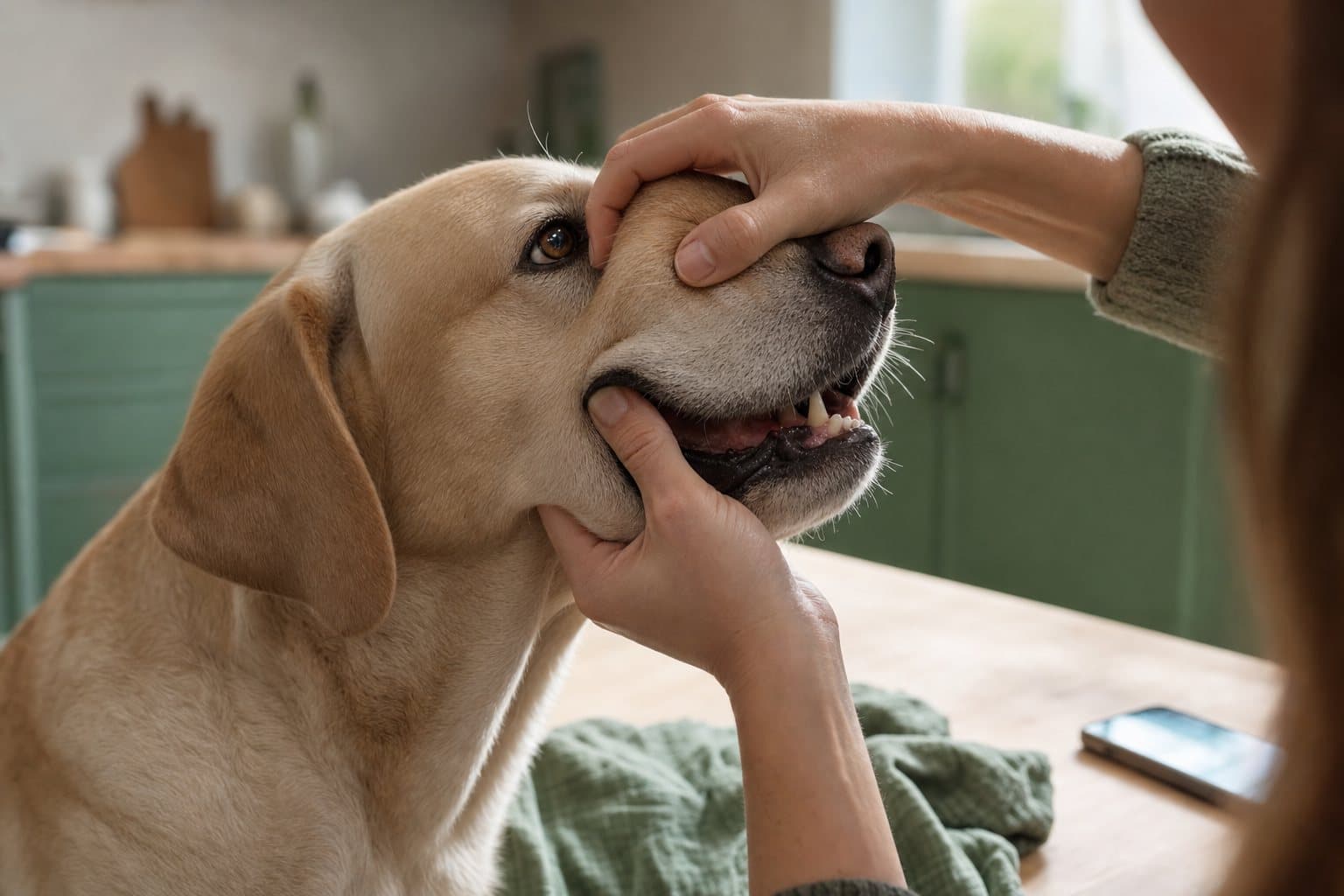
If your dog allows it, and there's no risk of being bitten, gently open its mouth and check whether you can see a foreign object in the mouth or throat. If the object is clearly visible and easy to reach, you can try to carefully remove it – ideally gripping it from the side, rather than pushing it further in. If you can't see the object clearly, or it's lodged deep, avoid blindly reaching your fingers deep into the throat – you risk pushing it in even further, or being bitten by a panicking animal.
If Your Dog Still Can't Breathe
If, after checking the mouth, your dog still isn't breathing properly, some owners – particularly those trained in pet first aid courses – choose to give firm, open-palm blows between the dog's shoulder blades and, if needed, apply pressure to the abdomen just behind the ribs (a manoeuvre similar to the Heimlich manoeuvre used in people), to create pressure in the airway that might dislodge the object. If you haven't had this kind of training, don't waste time on attempts you're not confident about – the most important thing is getting to a vet as quickly as possible, ideally calling the practice ahead so they know you're coming with a suspected choking case.
What Not to Do
Don't waste time on repeated, ineffective attempts at home intervention if you can see the dog isn't improving – in that situation, what matters is getting to the practice as fast as possible. Don't give your dog anything by mouth (water, food, any preparation at all) during the episode, until the airway is clear, and don't restrain your dog in a way that would further limit the movement of its chest.
Follow-Up After Successfully Removing an Object
Even if you manage to remove the object blocking the airway yourself, and your dog immediately seems to be breathing normally again, it's still worth contacting the practice and describing the whole situation. The violent, chaotic breathing during a choking episode carries a risk of accidentally inhaling saliva, stomach contents, or small fragments of the object, which can lead to aspiration pneumonia in the following hours – a complication that doesn't always show visible signs straight away. The vet will assess whether the situation calls only for observation at home, a follow-up check, or further diagnostics, especially if coughing, lethargy, or a raised temperature persist after the episode.
A fully blocked airway is a state of immediate, life-threatening danger, in which individual minutes matter. If you suspect your dog is genuinely choking, rather than having a reverse sneezing episode – don't wait to see if it improves, and don't try to "wait and see." Get to the nearest open veterinary practice or emergency clinic as fast as you can, calling ahead on the way if possible, so the team can be ready for your arrival.
Other Causes of Breathing Difficulty in Dogs
Reverse sneezing and choking are only two of the possible reasons owners call us, worried that their dog "is choking." It's worth knowing about other, less obvious causes too.
Brachycephalic Airway Syndrome
Dogs with a short, flattened muzzle – pugs, French and English bulldogs, Pekingese, boxers, shih tzus, and other breeds with a similar skull shape – have an anatomically narrowed, less efficient upper airway. Many of them have loud, snoring-like breathing on an everyday basis, and exertion, heat, or excitement can intensify the symptoms all the way to obvious breathlessness. This is a separate issue from reverse sneezing and choking, and calls for individual assessment by a vet, especially if symptoms are getting worse.
Laryngeal Inflammation and Paralysis
In older dogs and large breeds, the muscles responsible for opening the larynx during breathing can sometimes weaken or become paralysed, which shows up as loud, harsh breathing, particularly pronounced after exertion or in warm conditions, and in advanced cases leads to genuine breathing difficulty.
Tracheal Collapse
In small dog breeds, especially Yorkshire terriers, Pomeranians, or Chihuahuas, a relatively common problem is weakening of the cartilage rings of the trachea, which can lead to it partially collapsing. A typical symptom is a distinctive, dry cough that sounds like "a goose honking," which gets worse with excitement, exertion, or pulling against a lead attached to a collar – which is why dogs with this tendency are usually advised to wear a harness instead of a collar.
Upper Airway Infections
Infectious upper airway diseases, sometimes commonly referred to as "kennel cough" or "dog flu," can cause coughing, nasal discharge, and, in some cases, episodes resembling reverse sneezing or breathing difficulty, particularly in puppies, older dogs, or those with weakened immunity.
Allergic Reactions and Swelling
A severe allergic reaction, for example after an insect sting, can lead to swelling of the muzzle, throat, and larynx, and in extreme cases to a significant reduction in airway patency. This is a situation that often develops quickly and definitely calls for urgent veterinary attention.
Heart and Lung Disease, and Overheating
Heart and lung disease can present as chronic, gradually worsening respiratory effort, rather than a sudden, dramatic episode – it's worth watching for whether your dog is breathing with an open mouth at rest more often than usual, tires more quickly, or coughs after exercise or at night. A separate, seasonal cause of sudden breathing difficulty is overheating and heatstroke, particularly on hot days, in brachycephalic, overweight, older dogs, or those left without access to shade and water.
Growths in the Larynx and Throat
In older dogs, chronic, gradually worsening breathing difficulty, or a change in the sound of their bark, can also be linked to the presence of growths (tumours) or polyps in the larynx, throat, or nasal cavity. This is another reason why chronic or progressive respiratory symptoms – as opposed to a single, brief reverse sneezing episode – are always worth discussing with a vet, ideally before they become a serious limitation on breathing.
Foreign Objects That Don't Fully Block the Airway
Not every foreign object in the airway causes symptoms as dramatic as the full choking episode described above. Sometimes a small item – a blade of grass inhaled through the nose while sniffing the lawn, a small fragment of a toy or a bone – ends up lodged further down, in the trachea or bronchi, without blocking them completely. This can be mistaken for an ordinary infectious cough, since it shows up as a recurring, persistent cough, or gagging during exertion, rather than sudden, dramatic breathlessness. If a cough appears suddenly, especially after playing outside or chewing on something unusual, and doesn't clear up after a few days, make sure to mention it to your vet – imaging, or sometimes an endoscopic exam, may be needed to rule out a foreign object further down the airway.
When Breathing Difficulty Is an Emergency – Don't Wait
Regardless of the suspected cause, the following symptoms always call for immediate contact with a vet or the nearest 24-hour emergency practice:
- bluish, grey, or very pale discolouration of the gums, tongue, or lips,
- breathing with a wide-open mouth combined with obvious panic and distress,
- loud, wheezing, or harsh breathing that doesn't let up,
- no improvement after removing the suspected cause (e.g. after ventilating the room),
- weakness, stumbling, fainting, or loss of consciousness,
- suspected swallowing of a foreign object combined with escalating distress,
- signs of heatstroke (intense panting, weakness, vomiting after exposure to high temperatures).
In none of these situations is it worth waiting "until tomorrow," or counting on the symptoms clearing up on their own. The sooner your dog is in a vet's care, the better the chances of quick, effective help.
How to Reduce the Risk of Choking and Breathing Problems
Puppies and Exploring the World Mouth-First
Puppies explore their surroundings mainly by sniffing and chewing, which naturally increases the risk of swallowing something dangerous – anything from toys to items of clothing, pebbles, or food scraps found on a walk. It's worth puppy-proofing your home especially carefully before bringing a puppy home – putting away small objects, string, rubber bands, batteries, and anything else that could be swallowed, and keeping a close eye on walks for whatever your puppy picks up in its mouth. It's considerably easier to prevent a problem before it happens than to react to choking once it already has.
Safe Toys and Treats
Choose toys and treats suited to your dog's size and temperament – overly small parts, easily splintering sticks, or bones that dogs can chew into sharp fragments, all increase the risk of choking. Watch your dog when it plays with new toys, and replace any that start breaking apart into smaller pieces.
Supervision During Eating and Play
Dogs that eat very fast and greedily are at greater risk of choking – slow-feeder bowls can help in these cases. It's also worth teaching your dog a "leave it" or "drop it" command, which makes it easier to intervene quickly before it manages to swallow a dangerous object.
Limiting Irritants for Dogs Prone to Reverse Sneezing
If your dog tends to have more frequent reverse sneezing episodes, it's worth limiting strong smells in its environment – perfume, air fresheners, cigarette smoke – and avoiding sudden temperature changes wherever possible.
A Harness Instead of a Collar
For small dog breeds, and those with a tendency towards tracheal collapse, a good habit is using a harness instead of a collar fastened around the neck, especially on walks on a lead, where a sudden jerk could further irritate the throat and larynx.
Weight Control and Caution in Hot Weather
Keeping your dog at a healthy weight takes pressure off the respiratory system, and on hot days it's worth limiting intense exercise, making sure there's access to shade and fresh water, and paying particularly close attention to brachycephalic breeds, which are more prone to overheating.
What Happens During a Vet Visit After a Worrying Episode
History-Taking and Describing the Episode
Diagnosis always starts with a thorough history – when the episode happened, how long it lasted, what the dog was doing right before it started (playing, eating, on a walk, strong emotions), whether similar situations have happened before and how often, and whether a new smell, product, or other potential irritant has appeared in the dog's environment. If you have a recording of the episode, as discussed above, this is the best moment to show it.
Clinical Examination
The vet will listen to the heart and lungs, assess the patency and symmetry of airflow through both sides of the nose, examine the mouth, throat and, where possible, the larynx, and check for enlarged lymph nodes around the neck. In brachycephalic breeds, the assessment of the upper airway is often extended to a more detailed look at the structure of the nostrils, soft palate, and larynx.
Further Tests
Depending on the suspected cause and how often episodes occur, the vet may suggest further tests – an X-ray of the chest or neck area, blood tests, and in some cases, for recurring or unusual symptoms, referral to a specialist centre equipped for airway endoscopy. Not every episode calls for such extensive diagnostics – the vet always tailors the scope of testing individually, depending on how often symptoms occur, how severe they are, and whether other worrying signs accompany them.
Frequently Asked Questions
Is reverse sneezing dangerous for a dog?
A reverse sneezing episode on its own usually isn't life-threatening and passes by itself, even though it looks and sounds dramatic. If episodes become frequent or prolonged, though, or are accompanied by other worrying symptoms, it's worth consulting a vet to rule out other causes.
How do I tell reverse sneezing apart from real choking?
Reverse sneezing is a rhythmic, repeated inhalation of air through the nose, during which the dog stays conscious, alert, and usually stands in a characteristic posture with its neck stretched out, and the episode passes by itself after a short while. Real choking looks much more chaotic – the dog panics, paws at its muzzle, struggles to make any sound at all, and in more serious cases the gums turn blue and the dog weakens in a way that doesn't pass on its own. If in doubt, it's always safer to call the practice and describe exactly what you're seeing – the tone of your voice, your dog's posture, and whether it responds when you call it.
Can I do something at home to stop a reverse sneezing episode?
Usually it's enough to gently hold your dog's muzzle closed, cover its nose with a finger for a moment, and calmly stroke its throat to encourage it to swallow. Don't give your dog any medication or home remedies without consulting a vet first.
What should I do if my dog is choking and I'm home alone?
Stay as calm as you can, check your dog's mouth for a visible foreign object, and if it's easy to reach, try to carefully remove it. If that doesn't help, get to the nearest veterinary practice with your dog as quickly as possible, calling ahead on the way if you can, so the team knows what to expect.
Are short-nosed breeds, like pugs or bulldogs, more prone to breathing problems?
Yes. The anatomy of the upper airway in brachycephalic dogs makes them more prone both to reverse sneezing and to more serious breathing difficulties, especially during exertion, heat, or strong emotions. It's worth avoiding intense exercise during the hottest parts of the day for these breeds, using a harness instead of a collar, and keeping a close eye on their breathing, reacting immediately to any clear worsening rather than waiting until the dog starts visibly failing.
How long does a typical reverse sneezing episode last, and when should it worry me?
A single episode usually passes on its own after a short while. What should prompt concern, and a visit to the vet, is episodes that drag on, that recur more and more often, or that come with additional symptoms such as nasal discharge, blood, a change in voice, or a general decline in your dog's condition.
When should I take my dog to emergency care, and when can it wait until the next working day?
If you notice blue gums, no improvement despite attempts to clear the airway, severe and worsening breathlessness, fainting, loss of consciousness, or suspicion of a swallowed foreign object with escalating distress – that's always a reason for immediate contact with emergency veterinary care, not for waiting. In other, milder cases – such as a single, brief reverse sneezing episode with no additional symptoms – it's usually enough to book a routine check-up.
A phone call that starts with the words "help, my dog is choking" most often ends, in our everyday practice at the Hau-Miau clinic at ul. Siemieńskiego 23 in Warsaw's Ochota district, with an explanation, some reassurance, and, if needed, a calm follow-up visit booked in – because in the vast majority of cases, what's happening is a mild, if loud and frighteningly dramatic-sounding, reverse sneezing episode. Sometimes, though, that same phone call concerns a genuine, life-threatening emergency, which is exactly why it's worth knowing which symptoms to watch for and how to act in those first, critical minutes. If you have any doubts at all about your dog's health – whether related to breathing or to any other worrying symptom – don't delay getting in touch. Book a visit — call +48 22 823 35 63.